
Tazria – Metzora:
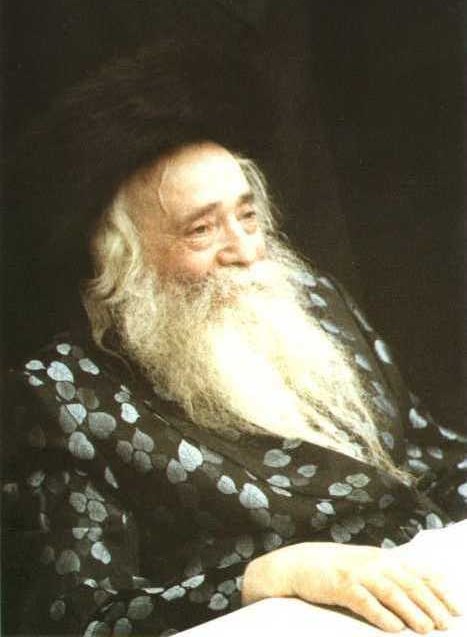
I recently came across the following mindblowing story about the Klausenberger Rebbe, Rabbi Yekusiel Yehuda Halberstam, whose first wife and ten children were murdered in the Holocaust.
He was in a few different workcamps and then spent some time in the Auchwitz concentration camp. After the war, he remarried and created a new family, moved to Israel, rebuilt his Chassidus and community and set up the Laniado hospital in Netanya.
Here is the story; a direct translation of the Rebbe’s own words from a recording of a talk he gave:
I was in the camps and I didn’t want to eat non-Kosher. I arrived at Auchwitz on a Friday. They immediately forced us off the carriages and began beating us with batons, making us run quickly into the camp. It was around 10am when we arrived.
They brought us food, food that they called “meaty”. I have no idea if it had real meat in it, but that is what they called it. Everyone was starving and wanted to eat, so they called me too. “Come and eat! Come and eat!”
I thought to myself, ‘Should I eat non-Kosher meat? What are they saying? Here, among evil I will eat non-Kosher? Is it not enough that the Nazis have taken everything from me, everything that I owned, physically, emotionally, spiritually. And I should also eat non-Kosher?!’ I ended up fasting all day Friday. That Friday night I was already very weak. I lay down, I wasn’t hardly able to move.
On Shabbos morning there was again an announcement calling us to come and take food, but I didn’t go. I stayed behind while the hut emptied, and I was left alone. Suddenly a fountain of tears opened up within me. I never normally cry – If Hashem wants something, so it should be. I always say, how Hashem wants something, that is what I want too. But that Shabbos afternoon the tears flowed for me.
“Master of the Universe,” I screamed out. “You have taken everything from me; even the clothes on my back and the shoes on my feet have been taken. I am left with nothing, and I lie here surrounded by these evil Nazis, should I go and eat non-Kosher? Master of the Universe! I don’t want to eat non-Kosher!”
And as I am crying there alone in the hut, someone runs in and asks, “Are you the Klausenberger Rebbe?” I was very alarmed because I didn’t want people to know that I was a Rebbe, for the Rabbis were generally the first that the Nazis killed. But then another person runs up to the hut and says, ‘Rebbe, you have to go, there is someone standing by the entrance of the camp waiting for you.”
Someone waiting for me? Well it was clear that I would not be able to stay undercover anymore. I had no idea if it was a member of the S.S. or perhaps a kapo, but I had to go to the entrance.
When I got there, a man was standing waiting, and he said to me, “Please tell me, was the Rabbi of Koshonov your uncle?”I stared at this unknown man in confusion. How did he know that I was here? And how did he know who my holy uncle was? I didn’t have much choice by now so I answered, “Yes.”
He said, “I brought you bread and a plate of marmalade so you have something to eat.”
I peer inside the package and it is exactly as he said. If he had brought me half a million dollars it would have been worth nothing compared to this. He brought me bread to eat! A big chunk of bread. With a large plate of marmalade!
“Take it back to your room and eat,” the man said.
By this point I had calmed down. I realized that there is a Master of the universe even here in this evil place. How could anyone know I was in Aushwitz. Who would know I needed food? I understood I had been correct in not eating the non-Kosher food and I took upon myself that, whatever may be, I would not eat non-Kosher. If Hashem can send me bread with marmalade – should I eat non-Kosher?!
I searched for a tiny amount of water to wash my hands. I then said Kiddush on the bread and had my Shabbos meal. I never saw that man again.
I spent a whole year surviving in that evil place. I don’t have the words to thank and praise Hashem for even a tiny portion of the miracles that He did for me. Many times they wanted to kill me, several times I was already lying on the ground waiting for them to shoot, but I survived it all, without eating non-Kosher. And more than that – with almost no desecration of Shabbos. I was guarded by Heaven!
These are the words from the holy mouth of the Klausenberger, a holy mouth that would not eat non-Kosher meat (even though, according to strict Halacha, one is allowed to, if it is a life-saving situation).
This story brings to mind the hostage Agam Berger who, according to her friends who were with her, refused to eat non-Kosher meat throughout her time in captivity, greatly limiting what she was able to eat. Throughout our history, and right now in our generation, there are those who are willing to give up everything for Hashem and the Jewish people, something that is particularly on our minds this week.
Last week’s Parsha concludes with the laws of kosher and non-kosher animals. This week’s double Parsha of Tazria Metzora deals with the topic of Tzaraat, an affliction of the skin which the Sages say came as a result of speaking Lashon Hara. Two topics that are perhaps one; what we put into our mouth and what we bring out of it.
For the vast majority of us, keeping Kosher is not something we have to suffer (apart from perhaps monetarily!) to achieve. We don’t have to take real risks or stand up for our principles when it comes to what goes into our mouth. The acceptance within society of different religious practices has made it fairly straightforward; you can have your kosher food on an airplane, at work meetings, on cruises, even when dining with British royalty or US presidents.
But when it comes to what comes out of our mouth, and standing up for the correct Kosher principles of speech, it is much much harder. We will be seen as different, weird, ‘holier-than-thou’, unfriendly, unsociable and more, if we refuse to engage in negative speech. We may suffer in a job setting, never really progressing in the company because we won’t build relationships based on putting down others. We may feel isolated, we may lose some friends, we may find ourselves in uncomfortable situations.
Perhaps, if we don’t have to stand up for what goes into our mouths, we should stand up for what comes out. We may not have Tzaraat nowadays, but the concept that Lashon Hara brings ‘plagues’ and difficulties to the Jewish people has not gone away. If we want our people, our soldiers, those in captivity, to be safe and free, if we want the suffering of the Jewish people to end, we have to ask ourselves, are we willing to take a stand regarding Lashon Hara, however difficult it may be, to protect our people?